Monday, November 27, 2006

Threadless Concurrency on the JVM - aka Scala Actors

Billy has written an interesting blog on the impact of multicore processors on Java. He concludes that the Java EE platform will have to be redressed to some extent in order to address the new threading patterns that applications will use and the consequences of reduced clock speed to accomodate the extra cores on the die. He has made some very thoughtful observations regarding the evolution of the future Java EE platforms and the JVM. Definitely worth a couple of reads ..

Concurrency Concurrency

One of the commonly mentioned fallouts of the new processor architectures is the new face of the applications written on the JVM. In order to take performance advantage from the multiple cores, applications need to be more concurrent, programmers need to find more parallelism within the application domain. Herb Sutter sums it up nicely in this landmark article :
But if you want your application to benefit from the continued exponential throughput advances in new processors, it will need to be a well-written concurrent (usually multithreaded) application. And that’s easier said than done, because not all problems are inherently parallelizable and because concurrent programming is hard.


Look Maa ! No Threads !

Writing multi-threaded code is hard, and, as the experts say, the best way to deal with multi-threading is to avoid it. The two dominant paradigms of concurrency available in modern day languages are :

  • Shared State with Monitors, where concurrency is achieved through multiple threads of execution synchronized using locks, barriers, latches etc.

  • Message Passing, which is a shared-nothing model using asynchronous messaging across lightweight processes or threads.


The second form of concurrent programming offers a higher level of abstraction where the user does not have to interact directly with the lower level primitives of thread models. Erlang supports this model of programming and has been used extensively in the telecommunications domain to achieve a great degree of parallelism. Java supports the first model, much to the horror of many experts of the domain and unless you are Brian Goetze or Doug Lea, designing concurrent applications in Java is hard.

Actors on the JVM

Actor based concurrency in Erlang is highly scalable and offers a coarser level of programing model to the developers. Have a look at this presentation by Joe Armstrong which illustrates how the share-nothing model, lightweight processes and asynchronous messaging support makes Erlang a truly Concurrency Oriented Programming Language. The presentation also gives us some interesting figures - an Erlang based Web server supported more than 80,000 sessions while Apache crashed at around 4,000.

The new kid on the block, Scala brings Erlang style actor based concurrency on the JVM. Developers can now design scalable concurrent applications on the JVM using the actor model of Scala which will automatically take advantage of the multicore processors, without programming to the complicated thread model of Java. In applications which demand large number of concurrent processes over a limited amount of memory, threads of the JVM, prove to be of significant footprint because of stack maintenance overhead and locking contentions. Scala actors provide an ideal model for programming in the non-cooperative virtual machine environment. Coupled with the pattern matching capabilities of the Scala language, we can have the full power of Erlang style concurrency on the JVM. The following example is from this recent paper by Philipp Haller and Martin Odersky:


class Counter extends Actor {
  override def run(): unit = loop(0)

  def loop(value: int): unit = {
    Console.println("Value: " + value)
    receive {
      case Incr() => loop(value + 1)
      case Value(a) => a ! value; loop(value)
      case Lock(a) => a ! value
        receive { case UnLock(v) => loop(v) }
      case _ => loop(value)
    }
  }
}


and its typical usage also from the same paper :


val counter = new Counter // create a counter actor
counter.start() // start the actor
counter ! Incr() // increment the value by sending the Incr() message
counter ! Value(this) // ask for the value

// and get it printed by waiting on receive
receive { case cvalue => Console.println(cvalue) }


Scala Actors

In Scala, actors come in two flavors -

  1. Thread based actors, that offer a higher-level abstraction of threads, which replace error-prone shared memory accesses and locks by asynchronous message passing and

  2. Event based actors, which are threadless and hence offer the enormous scalability that we get in Erlang based actors.


As the paper indicates, event based actors offer phenomenal scalability when benchmarked against thread based actors and thread based concurrency implementations in Java. The paper also demonstrates some of the cool features of library based design of concurrency abstractions in the sense that Scala contains no language support for concurrency beyond the standard thread model offered by the host environment.

I have been playing around with Scala for quite some time and have been thoroughly enjoying the innovations that the language offers. Actor based concurrency model is a definite addition to this list, more so since it promises to be a great feature that programmers would love to have as part of their toolbox while implementing on the JVM. JVM is where the future is, and event based actors in Scala will definitely be one of the things to watch out for ..

Monday, November 20, 2006

Use Development Aspects to Enforce Concurrency Idioms in Java Applications

Java 5 has given us a killer concurrency library in java.util.concurrent. Mustang will add more ammunitions to the already performant landscape - now it is upto the developers to use it effectively for the best yield. If you are not Doug Lea and have been getting your hands dirty with the Executors and Latches and Barriers of java.util.concurrent, I am sure you must have realized that killer libraries also need quality programmers to deliver the good. I have been thinking of ways get some of the concurrency goodies into existing Java applications, who have recently migrated to the Java 5 platform and have still been struggling with performance problems on multithreaded programs. Of course for production environments, we cannot redesign things from scratch, however ingenuous solution we promise to deliver. However, in one of these recently migrated applications, it was one of my charters to do a code review and suggest a path of least resistance that can potentially introduce some of the improvements of java.util.concurrent without any major redesign.

I decided to approach the problem by trying to find out some of the obvious concurrency related problems that Brian Goetze has been harping upon in his Java Theory and Practice columns in IBM developerworks. The codebase was huge and has evolved over the last 3 years under the auspices of a myriad of programmers - hence I decided to equip myself with the most important crosscutting weapon, a range of development aspects that can point me to some of the possible problem areas. There may be some false positives, but overall the strategy worked .. the following post highlights some of them with some representative code snippets for illustration purposes.

Safe Publication of Objects #1

Do not allow the this reference to escape during construction. One typical scenario where programmers make mistake is to start a thread from within a constructor. And as Brian Goetze has pointed out, it is a definite anti-pattern. I wrote a small aspect for detecting this :


public aspect TrackEscapeWithThreadStartInConstructor {
  pointcut inConstructor() : initialization(org.dg.biz.*.new(..));
  pointcut threadStart() : call(void Thread.start());

  before() : cflow(inConstructor()) && threadStart() {
    throw new RuntimeException(
      "possible escape of this through thread start in constructor");
  }
}


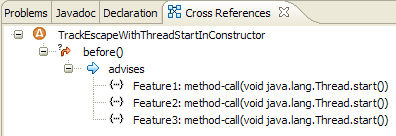
and Eclipse was quick to point me to the offending classes :


Safe Publication of Objects #2

Another anti-pattern when the this reference escapes from the constructor is when the programmer calls a non-static instance method from within the constructor of a class. Here is a small aspect that catches this anti-pattern :


public aspect TrackEscapeWithMethodCallInConstructor {
  pointcut inConstructor(Object o)
   : target(o)
    && withincode(org.dg.biz.*.new(..));

  pointcut callInstanceMethod()
   : call(!private !static * org.dg.biz.*.*(..));

  before(Object o) : inConstructor(o)
    && callInstanceMethod()
    && if (o.equals(thisJoinPoint.getTarget())) {

      throw new RuntimeException(
      "possible escape of this through instance method call in constructor");
  }
}


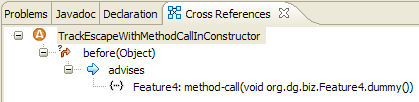
and Eclipse responds :


Using the New Concurrent Collections

Java 5 and Java 6 offer concurrent collection classes as definite improvements over the synchronized collections and can be used as drop in replacements in most of the cases. The older synchronized collection classes serialize all access to the collection, resulting in poor concurrency. The new ones (ConcurrentHashMap, CopyOnWriteArrayList etc.) offer better concurrency through locking at a finer level of granularity. If the traversal in the concurrent collections is the dominant operation, then these new collection classes can offer dramatic scalability improvements with little risk - for more information refer to Brian Goetze's excellent book on Java Concurrency in Practice.

I wrote the following aspect which pointed me to all possible uses of the synchronized collections in the codebase :


public aspect TrackSynchronizedCollection {
  pointcut usingSyncCollection() :
   call(public * java.util.Collections.synchronized*(..));

  declare warning
    : usingSyncCollection()
    : "consider replacing with Concurrent collections of Java 5";
}


We did a careful review and replaced many of those occurences with the newer collections - and we were able to achieve significant performance gains in some situations.

Handling the InterruptedException

In many places within the application that deal with blocking apis and multithreading, I found empty catch blocks as handlers of InterruptedException. This is not recommended as it deprives code higher up on the call stack of the opportunity to act on the interruption - once again refer to Brian Goetze for details.

However, a small aspect allows to get to these offending points :


public aspect TrackEmptyInterruptedExceptionHandler {
  pointcut inInterruptedExceptionHandler()
   : handler(InterruptedException+);

  declare warning
    : inInterruptedExceptionHandler()
    : "InterruptedException handler policy may not be defined";

  before() : inInterruptedExceptionHandler() {
    Thread.currentThread().interrupt();
  }
}


Development aspects are a great tool for refactoring and code review. I realized this first hand in the exercise that I did above and succeeded in identifying some of the anti-patterns of writing multi-threaded programs in Java and enforcing some of the common idioms and best practices across the codebase. In the above aspects, I have only scratched the surface - in fact developing a library of development aspects will be a great tool to the developer at large.

Monday, November 13, 2006

RIA, Echo2 and Programming Model

We, at Anshinsoft, have been working on our offering in the Reporting Solutions space - a WYSIWYG Report Designer and a full blown Enterprise Report Server. The Designer is a desktop Swing based application for designing reports, which, then can be deployed, managed and scheduled in the Enterprise Server.

As an additional plug-in, we would also like to have the Designer on the Web using the in-fashion RIA and Ajax architectural styles, which will enable users the usual flexibilities of a thin client application along with the richness that adds on to it. I have been exploring some of the architectural options towards this end, keeping in mind some of the constraints that we, as an organization have :

  • The current Designer has been implemented in Swing - we have a large programmer base who have delivered Java Swing based UIs and are familiar with the Swing programming model.

  • We do not have many Javascript programmers and as an organization are not equipped well enough to take up the seemingly daunting task of crafting a Javascript based architecture (aka client side Ajax)

  • I am comfortable with the first part of the previous point that we have a large Java programmer base. But based on the tonnes of Swing code that have been churned out in the current implementation, I am very much skeptical about the maintenability and the aesthetics of the codebase. In one of my previous posts, I had expressed my disliking of the Swing based programming model, which encourages lots of boilerplate stuff. Hence, I would like to move away from the naked model of Swing programming.


Enter Echo2

Based on the above constraints, I did some research and have ultimately arrived at Echo2 as the suggested platform for implementing the Web based Designer with a rich UI. The main pluses that I considered going with Echo2 are :

  • Completely Java based programming model, which nicely fits into the scheme of our organization expertise fabric.

  • Swing like apis which again score with respect to the familiarity metrics of the team.

  • Echo2 nicely integrates with Spring, which we use as the business layer.

  • I also considered GWT, but ultimately took on Echo2, because GWT is still in beta and does not have the same richness with respect to pre-built set of available components.


Concerns

The main concern that I have with Echo2 is, once again, related to the programming model - I am not a big admirer of the naked Swing model of programming. And here is the main gotcha .. I have been thinking of the following possibilities that can give me a more improved programming model on Echo2 :

  • Think MDA, use Eclipse EMF and openArchitectureWare to design models of the user interfaces and generate Echo2 code out of it. Then I maintain the models, which look much more pragmatic than maintaining a huge boilerplate style of codebase.

  • Has someone written something similar to Groovy SwingBuilder for Echo2, which I can use as a markup.

  • Use some sort of Language Oriented Programming, maybe a small DSL using the JetBrains Meta Programming System(MPS).

  • Write a homegrown abstraction layer on top of Echo2 that incorporates FluentInterfaces like goodies and offers a better programming model.


I would really like to go for a more declarative programming model - in Echo2, the navigation and flow logic are completely embedded with the rendering part. Can I externalize it without writing lots of framework code ?

Why not WebOnSwing or similar stuff ?

I do not want to deploy the existing Swing application - it has evolved over the years and it is time we move on to a higher level of abstraction and capitalize on richer features and responsiveness of Ajax frameworks.

I would like to seek suggestions from experts on the above views. Any pointers, any suggestions that will help us make a positive move will be most welcome!

Monday, November 06, 2006

Domain Abstractions : Abstract Classes or Aspect-Powered Interfaces ?

In my last post I had discussed about why we should be using abstract classes instead of pure Java interfaces to model a behavior-rich domain abstraction. My logic was that rich domain abstractions have to honor various constraints, which cannot be expressed explicitly by pure interfaces in Java. Hence leaving all constraints to implementers may lead to replication of the same logic across multiple implementations - a clear violation of the DRY principle.

However, lots of people expressed their opinions through comments in my blog and an interesting discussion on the Javalobby forum, where I found many of them to be big proponents of *pure* Java interfaces. All of them view Java interfaces as contracts of the abstraction and would like to undertake the pain of extreme refactoring in order to accomodate changes in the *published* interfaces. This post takes a relook at the entire view from the world of interfaces and achieve the (almost) same effect as the one described using abstract classes.

Interfaces Alone Don't Make the Cut!

Since pure Java interfaces cannot express any behavior, it is not possible to express any constraint using interfaces alone. Enter aspects .. we can express the same behavioral constraints using aspects along with interfaces.

Continuing with the same example from the previous post :-

The interface ..


interface IValueDateCalculator {
  Date calculateValueDate(final Date tradeDate)
      throws InvalidValueDateException;
}


and a default implementation ..


public class ValueDateCalculator implements IValueDateCalculator {
  public Date calculateValueDate(Date tradeDate)
      throws InvalidValueDateException {
    // implementation
  }
}


Use aspects to power up the contract with mandatory behavior and constraints ..


public aspect ValueDateContract {

  pointcut withinValueDateCalculator(Date tradeDate) :
      target(IValueDateCalculator) &&
      args(tradeDate) &&
      call(Date calculateValueDate(Date));

  Date around(Date tradeDate) : withinValueDateCalculator(tradeDate) {

    if (tradeDate == null) {
      throw new IllegalArgumentException("Trade date cannot be null");
    }

    Date valueDate = proceed(tradeDate);

    try {
      if (valueDate == null) {
        throw new InvalidValueDateException(
          "Value date cannot be null");
      }

      if (valueDate.compareTo(tradeDate) == 0
        || valueDate.before(tradeDate)) {
        throw new InvalidValueDateException(
          "Value date must be after trade date");
      }

    } catch(Exception e) {
      // handle
    }

    return valueDate;
  }
}


Is this Approach Developer-friendly ?

Aspects, being looked upon as an artifact with the *obliviousness* property, are best kept completely decoupled from the interfaces. Yet, the complete configuration of a contract for a module can be known only with the full knowledge of all aspects that weave together with the interface. Hence we have the experts working on how to engineer aspect-aware-interfaces as contracts for the modules of a system, yet maintaining the obliviousness property.

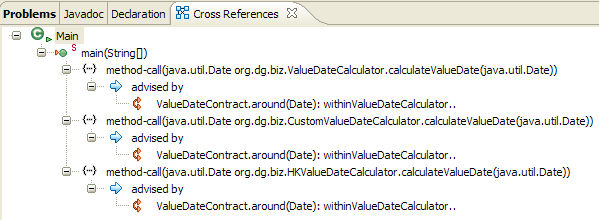
While extending from an abstract class, the constraints are always localized within the super class for the implementer, in this case, the aspects, which encapsulate the constraints, may not be "textually local". Hence it may be difficult for the implementer to be aware of these constraints without strong tooling support towards this .. However, Eclipse 3.2 along with ajdt shows all constraints and advices associated with the aspect :

at aspect declaration site ..


and at aspect call site ..


And also, aspects do not provide that much fine grained control over object behavior than in-situ Java classes. You can put before(), after() and around() advices, but I still think abstract classes allow a more fine grained control over assertion, invariant and behavior parameterization.

Dependencies, Side-effects and Undocumented Behaviors

In response to my last post, Cedric had expressed the concern that with the approach of modeling domain abstractions using abstract classes with mandatory behavioral constraints

Before you know it, your clients will be relying on subtle side-effects and undocumented behaviors of your code, and it will make future evolution much harder than if you had used interfaces from the start.


I personally feel that for mandatory behaviors, assertions and invariants, I would like to have all concrete implementations *depend* on the abstract class - bear in mind that *only* those constraints go to the abstract class which are globally true and must be honored for all implementations. And regarding unwanted side-effects, of course, it is not desirable and often depends on the designer.

From this point of view, the above implementation using interfaces and aspects also suffer from the same consequences - implementers depend on concrete aspects and are always susceptible to unwanted side-effects.

Would love to hear what others feel about this ..

Tuesday, October 31, 2006

Domain Classes or Interfaces ?

A few days back I had initiated a thread in the mailing list of Domain Driven Design regarding the usage of pure Java interfaces as the contract for domain objects. The discussion turned out to be quite interesting with Sergio Bossa pitching in as the main supporter of using pure interfaces in the domain model. Personally I am not a big camp follower of the pure-interfaces-as-intention-revealing paradigm - however, I enjoyed the discussion with Sergio and the other participants of the group. Sergio has posted the story with his thoughts on the subject. The current entry is a view from the opposite camp and not really a java pure-interface love affair.

The entire premise of the Domain Driven Design is based upon evolving a domain model as the cornerstone of the design activity. A domain model consists of domain level abstractions, which builds upon intention revealing interfaces, built out of the Ubiquitous Language. And when we talk about abstractions, we talk about data and the associated behavior. The entire purpose behind DDD is to manage the complexity in the modeling of these abstractions, so that we have a supple design that can be carefully extended by the implementers and easily used by other clients. In the process of extension, the designer needs to ensure that the basic assumptions or behavioral constraints are never violated and the abstractions' published interfaces always honor the basic contractual framework (pre-conditions, post-conditions and invariants). Erik Evans never meant Java interfaces when he talked about intention-revealing-interfaces - what he meant was more in terms of contract or behavior to be modeled with the most appropriate artifact available in the language of implementation.

Are Java interfaces sufficiently intention-revealing ?

The only scope that the designer has to reveal the intention is through the naming of the interface and its participating methods. Unfortunately Java interfaces are not rich enough to model any constraints or aspects that can be associated with the published apis (see here for some similar stuff in C#). Without resorting to some of the non-native techniques, it is never possible to express the basic constraints that must be honored by every implementation of the interface. Let us take an example from the capital market domain :


interface IValueDateCalculator {
  Date calculateValueDate(final Date tradeDate)
      throws InvalidValueDateException;
}


The above interface is in compliance with all criteria for an intention-revealing-interface. But does it provide all the necessary constraints that an implementor need to be aware of ? How do I specify that the value-date calculated should be a business date after the trade date and must be at least three business dates ahead of the input trade-date ? Pure Java interfaces do not allow me to specify any such criteria. Annotations also cannot be of any help, since annotations on an interface do not get inherited by the implementations.

Make this an abstract class with all constraints and a suitable hook for the implementation :


abstract class ValueDateCalculator {
  public final Date calculateValueDate(final Date tradeDate)
      throws InvalidValueDateException {
    Date valueDate = doCalculateValueDate(tradeDate);
    if (DateUtils.before(valueDate, tradeDate) {
      throw new InvalidValueDateException("...");
    }
    if (DateUtils.dateDifference(valueDate, tradeDate) < 3) {
      throw new InvalidValueDateException("...");
    }
    // check other post conditions
  }

  // hook to be implemented by subclasses
  protected abstract Date doCalculateValueDate(final Date tradeDate)
      throws InvalidValueDateException;
}


The above model checks all constraints that need to be satisfied once the implementation calculates the value-date through overriding the template method. On the contrary, with pure interfaces (the first model above), in order to honor all constraints, the following alternatives are available :

  • Have an abstract class implementing the interface, which will have the constraints enforced. This results in an unnecessary indirection without any value addition to the model. The implementers are supposed to extend the abstract class (which anyway makes the interface redundant), but, hey, you cannot force them. Some adventurous soul may prefer to implement the interface directly, and send all your constraints for a toss!

  • Allow multiple implementations to proliferate each having their own versions of constraints implementations - a clear violation of DRY.

  • Leave everything to the implementers, document all constraints in Javadoc and hope for the best.


Evolving Your Domain Model

Abstract classes provide an easy evolution of the domain model. The process of domain modeling is iterative and evolutionary. Hence, once you publish your apis, you need to honor their immutability, since all published apis will potentially be used by various clients. Various schools of thought adopt different techniques towards achieving this immutability. Eclipse development team use extension of interfaces (The Extension Object Design Pattern) and evolve their design by naming extended interfaces suffixed by a number - the I*2 pattern of interface evolution. Have a look at this excellent interview with Erich Gamma for details on this scheme of evolution. While effective in some situations where you need to implement multiple inheritance, I am not a big fan of this technique for evolving my domain abstractions - firstly, this technique does not scale and secondly, it requires an instanceof check in client code, which is a code-smell, as the gurus say.

Once again, to support smooth evolution of your domain apis, you need to back your interfaces with an abstract class implementation and have the implementers program to the abstract class, and not the interface. Then what good is the interface for ?


Are Interfaces Useless in DDD ?

Certainly not. I will use pure interfaces to support the following cases :

  • Multiple inheritance, particularly mixin implementations

  • SPIs, since they will always have multiple implementations and fairly disjoint ones too. The service layer is one which is a definite candidate for interfaces. This layer needs easy mocking for testability, and interfaces fit this context like a charm.


Some of the proponents of using interfaces claim testability as a criterion for interface based design, because of the ease of mockability. Firstly, I am not sure if domain objects can be tested effectively using mocking. Mocking is most suitable for the services and SPIs and I am a strong supporter of using interfaces towards that end. Even with classes, EasyMock supports mocking using CGLIB and proxies.

Finally ...

I think abstract classes provide a much more complete vehicle for implementation of behavior rich domain abstractions. I prefer to use interfaces for the SPIs and other service layers which tend to have multiple implementations and need easy mocking and for situations where I need multiple inheritance and mixin implementations. I would love to hear what the experts have to say on this ..

Monday, October 23, 2006

Why OOP Alone in Java is Not Enough

Object-oriented languages have taught us to think in terms of objects (or nouns) and Java is yet another example of the incarnation of the noun land. When was the last time you saw an elegant piece of Swing code ? Steve Yegge is merciless when he rants about it .. and rightly so ..
Building UIs in Swing is this huge, festering gob of object instantiations and method calls. It's OOP at its absolute worst.

There are ways of making OOP smart, we have been talking about fluent interfaces, OO design patterns, AOP and higher level of abstractions similar to those of DSLs. But the real word is *productivity* and the language needs to make your user elegantly productive. Unfortunately in Java, we often find people generating reams of boilerplates (aka getters and setters) that look like pureplay copy-paste stuff. Java abstractions thrive on the evil loop of the 3 C's create-construct-call along with liberal litterings of getters and setters. You create a class, declare 5 read-write attributes and you have a pageful of code before you start throwing in a single piece of actual functionality. Object orientation procrastinates public attributes, restricts visibility of implementation details, but never prevents the language from providing elegant constructs to handle boilerplates. Ruby does this, and does it with elan.


Java is not Orthogonal

Paul Graham in On Lisp defines orthogonality of a language as follows :
An orthogonal language is one inwhich you can express a lot by combining a small number of operators in a lot of different ways.

He goes on to explain how the complement function in Lisp has got rid of half of the *if_not* funtions from the pairs like [remove-if, remove-if-not], [subst-if, subst-if-not] etc. Similarly in Ruby we can have the following orthogonal usage of the "*" operator across data types :


"Seconds/day: #{24*60*60}" will give Seconds/day: 86400
"#{'Ho! '*3}Merry Christmas!" will give Ho! Ho! Ho! Merry Christmas!


C++ supports operator overloading, which is also a minimalistic way to extend your operator usage.

In order to bring some amount of orthogonality in Java we have lots of frameworks and libraries. This is yet another problem of dealing with an impoverished language - you have a proliferation of libraries and frameworks which add unnecessary layers in your codebase and tend to collapse under their weight.

Consider the following code in Java to find a matching sub-collection based on a predicate :


class Song {
  private String name;
  ...
  ...
}

// ...
// ...
Collection<Song> songs = new ArrayList<Song>();
// ...
// populate songs
// ...
String title = ...;
Collection<Song> sub = new ArrayList<Song>();
for(Song song : songs) {
  if (song.getName().equals(title)) {
    sub.add(song);
  }
}


The Jakarta Commons Collections framework adds orthogonality by defining abstractions like Predicate, Closure, Transformer etc., along with lots of helper methods like find(), forAllDo(), select() that operate on them, which helps user do away with boilerplate iterators and for-loops. For the above example, the equivalent one will be :


Collection sub = CollectionUtils.transformedCollection(songs,
    TransformerUtils.invokerTransformer("getName"));
CollectionUtils.select(sub,
  PredicateUtils.equalPredicate(title));


Yuck !! We have got rid of the for-loop, but at the expense of ugly ugly syntax, loads of statics and type-unsafety, for which we take pride in Java. Of course, in Ruby we can do this with much more elegance and lesser code :


@songs.find {|song| title == song.name }


and this same syntax and structure will work for all sorts of collections and arrays which can be iterated. This is orthogonality.

Another classic example of non-orthogonality in Java is the treatment of arrays as compared to other collections. You can initialize an array as :


String[] animals = new String[] {"elephant", "tiger", "cat", "dog"};


while for Collections you have to fall back to the ugliness of explicit method calls :


Collection<String> animals = new ArrayList<String>();
animals.add("elephant");
animals.add("tiger");
animals.add("cat");
animals.add("dog");


Besides arrays have always been a second class citizen in the Java OO land - they support covariant subtyping (which is unsafe, hence all runtime checks have to be done), cannot be subclassed and are not extensible unlike other collection classes. A classic example of non-orthogonality.

Initialization syntax ugliness and lack of literals syntax support has been one of the major failings of Java - Steve Yegge has documented it right to its last bit.

Java and Extensibility

Being an OO language, Java supports extension of classes through inheritance. But once you define a class, there is no scope of extensibility at runtime - you cannot define additional methods or properties. AOP has been in style, of late, and has proved quite effective as an extension tool for Java abstractions. But, once again it is NOT part of the language and hence does not go to enrich the Java language semantics. There is no meta-programming support which can make Java friendlier for DSL adoption. Look at this excellent example from this recent blogpost :

Creating some test data for building a tree, the Java way :


Tree a = new Tree("a");

Tree b = new Tree("b");
Tree c = new Tree("c");
a.addChild(b);
a.addChild(c);

Tree d = new Tree("d");
Tree e = new Tree("e");
b.addChild(d);
b.addchild(e);

Tree f = new Tree("f");
Tree g = new Tree("g");
Tree h = new Tree("h");
c.addChild(f);
c.addChild(g);
c.addChild(h);


and the Ruby way :


tree = a {
      b { d e }
      c { f g h }
    }


It is really this simple - of course you have the meta-programming engine backing you for creating this DSL. What this implies is that, with Ruby you can extend the language to define your own DSL and make it usable for your specific problem at hand.

Java Needs More Syntactic Sugars

Any Turing complete programming language has the ability to allow programmers implement similar functionalities. Java is a Turing complete language, but still does not boost enough programmer's productivity. Brevity of the language is an important feature and modern day languages like Ruby and Scala offer a lot in that respect. Syntactic sugars are just as important in making programmers feel concise about the implementation. Over the last year or so, we have seen lots of syntactic sugars being added to C# in the forms of Anomymous Methods, Lambdas, Expression Trees and Extension Methods. I think Java is lagging behind a lot in this respect. The smart for-loop is an example in the right direction. But Sun will do the Java community a world of good in offering other syntactic sugars like automatic accessors, closures and lambdas.

Proliferation of Libraries

In order to combat Java's shortcomings at complexity management, over the last five years or so, we have seen the proliferation of a large number of libraries and frameworks, that claim to improve programmer's productivity. I gave an example above, which proves that there is no substitute for language elegance. These so called productivity enhancing tools are added layers on top of the language core and have been mostly delivered as generic ones which solve generic problems. There you are .. a definite case of Frameworkitis. Boy, I need to solve this particular problem - why should I incur the overhead of all the generic implementations. Think DSL, my language should allow me to carve out a domain specific solution using a domain specific language. This is where Paul Graham positions Lisp as a programmable programming language. I am not telling all Java libraries are crap, believe me, some of them really rocks, java.util.concurrent is one of the most significant value additions to Java ever and AOP is the closest approximation to meta-programming in Java. Still I feel many of them would not have been there, had Java been more extensible.

Is it Really Static Typing ?

I have been thinking really hard about this issue of lack of programmer productivity with Java - is static typing the main issue ? Or the lack of meta-programming features and the ability that languages like Ruby and Lisp offer to treat code and data interchangeably. I think it is a combination of both the features - besides Java does not support first class functions, it doesn't have Closures as yet and does not have some of the other productivity tools like parallel assignment, multiple return values, user-defined operators, continuations etc. that make a programmer happy. Look at Scala today - it definitely has all of them, and also supports static typing as well.


In one of the enterprise Java projects that we are executing, the Maven repository has reams of third party jars (mostly open source) that claim to do a better job of complexity management. I know Ruby is not enterprise ready, Lisp never claimed to deliver performance in a typical enterprise business application, Java does the best under the current circumstances. And the strongest point of Java is the JVM, possibly the best under the Sun. Initiatives like Rhino integration, JRuby and Jython are definitely in the right direction - we all would love to see the JVM evolving as a friendly nest of the dynamic languages. The other day, I was listening to the Gilad Bracha session on "Dynamically Typed Languages on the Java Platform" delivered in Lang .NET 2006. He discussed about invokedynamic bytecode and hotswapping to be implemented in the near future on the JVM. Possibly this is the future of the Java computing platform - it's the JVM that holds more promise for the future than the core Java programming language.

Monday, October 09, 2006

AOP : Writing Expressive Pointcuts

Aha .. yet another rant on AOP and pointcuts, this time expressing some of the concerns with the most important aspect of aspects - the Pointcut Descriptors. In order for aspects to be a first class citizen of the domain modeling community, pointcut descriptors will have to be much more expressive than what they are today in AspectJ. Taking an example from one of the threads in "aspectj-users" forum, AOP expert Dean Wampler himself had made a mistake between call( @MyAnnotation *.new(..) ) and call( (@MyAnnotation *).new(..) ), while answering a query from another user. While the former pointcut matches all constructors annotated with @MyAnnotation, the latter matches constructors in classes where the class itself has the same annotation.

This is, at best, confusing - the syntax is not expressive and liberal sprinkling of position dependent wild card characters pose a real challenge to the beginners of AspectJ. Dean has some suggestions in his blog for making pointcut languages more expressive - as Dean has pointed out, the solution is to move towards a flexible DSL for writing pointcuts in AspectJ.

What we write today as :


execution(public !static * *(..))


can be expressed more effectively as :


execution(
  method()
  .access($public)
  .specifier(!$static)
)


The experts need to work out the complete DSL to make life easier for the beginners.


Pointcuts can be Intrusive

If not properly designed, pointcuts can directly bite into the implementation of abstractions. Consider the following example from the classic An Overview of AspectJ paper by Kiczales et. al. :


interface FigureElement {
  void incrXY(int x, int y);
}

class Point implements FigureElement {
  int x, y;
  // ...
}


Now consider the following two pointcuts :


get(int Point.x) || get(int Point.y)


and


get(* Shape+.*)


Both the above pointcuts match the same set of join points. But the first one directly intrudes into the implementation of the abstraction accessing the private fields, while the latter is based only on the interface. While both of them will have the same effect in the current implementation, but certainly, the first one violates the principle of "programming to the interface" and hence is not modular and scalable. While pointcuts have the raw power to cut into any levels of abstraction and inject advice transparently, care should be taken to make these pointcuts honor the ageold abstraction principles of the object oriented paradigm. As Bertrand Meyer has noted about OO contracts, pointcuts should also be pushed up the inheritance hierarchy in order to ensure maximal reusability.

Jonas Boner, while talking about invasive pointcuts has expressed this succinctly in his blog :
A pointcut can be seen as an implicit contract between the target code and the artifact that is using the pointcut (could be an aspect or an interceptor).
One problem with using patterns like this is that we are basing the implicit contract on implementation details, details are likely to change during the lifetime of the application. This is becoming an even bigger problem with the popularity of agile software development methodologies (like XP, Scrum, TDD etc.), with a high focus on refactoring and responsiveness to customer ever-changing requirements.


Metadata for Expressiveness

Ramnivas Laddad has talked about metadata as a multidimensional signature and has described annotations as a vehicle to prevent signature tangling and express any data associated with your code's crosscutting concerns. While annotations make code much more readable, but it is a compromise on one of the most professed principles of AOP - obliviousness. Annotations (and other mechanisms) can also be used to constrain advice execution on classes and interfaces. There have also been suggestions to have classes and interfaces explicitly restrict aspects or publish pointcuts. All of these, while publishing much more powerful interfaces for abstractions, will inherently limit the obliviousness property of AOP. See here for more details.

Use metadata to enhance the artifact being annotated, but the enhancement should be horizontal and NOT orthogonal. e.g. a domain model should always be annotated with domain level metadata and, as Jonas has rightly pointed out, it is equally important to use the Ubiquitous Language for annotating domain artifacts. Taking cue from the example Ramnivas has cited :


@Transactional
@Authorized
public void credit(float amount);


If the method credit() belongs to the domain model, it should never be annotated with service level annotations like @Transactional and @Authorized. These annotations go into service layer abstractions - the domain layer can contain only domain level metadata. Accordingly the pointcut processing for domain layers should not contain service layer functionality.

Tuesday, October 03, 2006

Agile Blast

Steve Yeggey @ Google has blasted Agile and InfoQ has carried a significant post on it. Rants like these sell like hot cakes and, no wonder, the last time I checked Steve's blogs, I found 161 comments posted against it. Martin Fowler has posted a quiet, but convincing dictum in his bliki regarding his agile practices in Thoughtworks. Of course, Martin's post contains no reference to Google Agile practices of Steve - but the timing is significant.

Any practice, done the wrong way is bad, and Agile is no exception. The Agile Manifesto never talks about imposition, never dictates any forceful action from the upper management - it talks about individuals, interactions and collaborations. It's never an enforcement of RigorousAgile.

We have been practicing many of the principles of agile methodology in Anshinsoft in our offshore software development model in India. To a large extent we have been quite satisfied with the results. We do *not* do pair programming, but we follow principles like customer collaboration, short iterative model of development, merciless refactoring, early builds and short release cycles. Developing in collaboration with the client team, 10,000 miles and 12 hour timezones away, these have worked out great for us.

Steve has mentioned about many of the Google practices. We need to understand that Google hires its staff after a very thorough and careful screening process, has a completely different business model and does not have to think about the red-faced fuming client hammering for the red dots of the project dashboard late at night. So whatever is Google Agile, cannot be applied to houses that deliver run-of-the-mill project solutions at nickel-a-line-of-code priceline.

Here are some of the other Yegge rants ..

- there are managers, sort of, but most of them code at least half-time, making them more like tech leads.


In a typical project, the project manager has to do external client management and keep all stakeholders updated about the project dashboard. Managers coding half of the time simply do not work in a large enterprise scale development project. Well, once again it may be a Google specialization, but for people working further down the intellectual curve, it's all bricks and mortars - managers need to work collaboratively with a very strong client facing role.

- developers can switch teams and/or projects any time they want, no questions asked; just say the word and the movers will show up the next day to put you in your new office with your new team.


A real joke when you are delivering a time critical project to your client. Again it's Google Agile, but definitely not applicable to the business model in which the lesser mortals thrive on.

- there aren't Gantt charts or date-task-owner spreadsheets or any other visible project-management artifacts in evidence, not that I've ever seen.


When you don't have the deadlines and the client manager sniffing at your project dashboard, you can indulge in creativity-unlimited - sorry folks, no place for this one too in my delivery model.

The agile methodology does not force you to use (or not use) Gantt charts or excel sheets for project management. It's all about adding flexibility and making your process easier to manage and make teams drift away from the reams of useless documentation. Agility, practiced bad is Bad Agile, but one model does not fit all and Google Agile is not for the general mass to follow.

Aspect Days are Here Again ..

and it's raining pointcuts in Spring. It is the most discussed about topic in the blogs and forums that Spring 2.0 will support AspectJ 5. I have been tickling with aspects for some time in the recent past and have also applied AOP in production environments. I have narrated that experience in InfoQ where I had used AOP to implement application level failover over database and MOM infrastructures. This post will be all about the afterthoughts of my continuing experiments with AOP as a first class modeling artifact in your OO design.

First Tryst with Domain Aspects

I am tired of looking at aspects for logging, tracing, auditing and profiling an application. With the new AspectJ 5 and Spring integration, you can do all sorts of DI and wiring on aspects using the most popular IoC container. Spring's own @Transactional and @Configurable are great examples of AOP under the hoods. However, I always kept on asking Show me the Domain Aspects, since I always thought that in order to make aspects a first class citizen in modeling enterprise applications, it has to participate in the domain model.

In one of our applications, we had a strategy for price calculation which worked with the usual model of injecting the implementation through the Spring container.


<beans>
  <bean id="defaultStrategy" class="org.dg.domain.DefaultPricing"/>

  <bean id="priceCalculation" class="org.dg.domain.PriceCalculation">
    <property name="strategy">
      <ref bean="defaultStrategy"/>
    </property>
  </bean>
</beans>


Things worked like a charm, till in one of the deployments, the client came back with the demand for implementing strategy failovers. The default implementation will continue to work as the base case, while in the event of failures, we need to iterate over a collection of strategies till one gets back with a valid result. Being a one of a kind of request, we decided NOT to change the base class and the base logic of strategy selection. Instead we chose to have a non-invasive way of handling the client request by implementing pricing strategy alternatives through a domain level aspect.


public aspect CalculationStrategySelector {

  private List<ICalculationStrategy> strategies;

  public void setStrategies(List<ICalculationStrategy> strategies) {
    this.strategies = strategies;
  }

  pointcut inCalculate(PriceCalculation calc)
    : execution(* PriceCalculation.calculate(..)) && this(calc);

  Object around(PriceCalculation calc)
    : inCalculate(calc) {
      int i = 0;
      int maxRetryCount = strategies.size();
      while (true) {
        try {
          return proceed(calc);
        } catch (Exception ex) {
        if ( i < maxRetryCount) {
          calc.setStrategy(getAlternativeStrategy(i++));
        } else {
          // handle exceptions
        }
      }
    }
  }

  private ICalculationStrategy getAlternativeStrategy(int index) {
    return strategies.get(index);
  }
}


And the options for the selector were configured in the configuration xml of Spring ..


<beans>
  <bean id="strategySelector"
    class="org.dg.domain.CalculationStrategySelector"
    factory-method="aspectOf">
    <property name="strategies">
      <list>
        <ref bean="customStrategy1"/>
        <ref bean="customStrategy2"/>
      </list>
    </property>
  </bean>

  <bean id="customStrategy1" class="org.dg.domain.CustomCalculationStrategy1"/>
  <bean id="customStrategy2" class="org.dg.domain.CustomCalculationStrategy2"/>
</beans>


The custom selectors kicked in only when the default strategy fails. Thanks to AOP, we could handle this problem completely non-invasively without any impact on existing codebase.

And you can hide your complexities too ..

Aspects provide a great vehicle to encapsulate many complexities out of your development team. While going through Brian Goetz's Java Concurrency In Practice, I found one snippet which can be used to test your code for concurrency. My development team has just been promoted to Java 5 features and not all of them are enlightened with the nuances of java.util.concurrent. The best way that I could expose the services of this new utility was through an aspect.

The following snippet is a class TestHarness and is replicated shamelessly from JCIP ..


package org.dg.domain.concurrent;

import java.util.concurrent.CountDownLatch;

public class TestHarness {
  public long timeTasks(int nThreads, final Runnable task)
    throws InterruptedException {
    final CountDownLatch startGate = new CountDownLatch(1);
    final CountDownLatch endGate = new CountDownLatch(nThreads);

    for(int i = 0; i < nThreads; ++i) {
      Thread t = new Thread() {
        public void run() {
          try {
            startGate.await();
            try {
              task.run();
            } finally {
              endGate.countDown();
            }
          } catch (InterruptedException ignored) {}
        }
      };
      t.start();
    }

    long start = System.nanoTime();
    startGate.countDown();
    endGate.await();
    long end = System.nanoTime();
    return end - start;
  }
}


My target was to allow my developers to write concurrency test codes as follows ..


public class Task implements Closure {

  @Parallel(5) public void execute(Object arg0) {
    // logic
    // ..
  }
}


The annotation @Parallel(5) indicates that this method need to be run concurrently in 5 threads. The implementation of the annotation is trivial ..


import java.lang.annotation.ElementType;
import java.lang.annotation.Retention;
import java.lang.annotation.RetentionPolicy;
import java.lang.annotation.Target;

@Target(ElementType.METHOD)
@Retention(RetentionPolicy.RUNTIME)
public @interface Parallel {
  int value();
}


The interesting part is the main aspect which implements the processing of the annotation in AspectJ 5 .. Note the join point matching based on annotations and the context exposure to get the number of threads to use for processing.


public aspect Concurrency {
  pointcut parallelExecutionJoinPoint(final Parallel par) :
    execution(@Parallel public void *.execute(..)) && @annotation(par);

  void around(final Parallel par) : parallelExecutionJoinPoint(par) {

    try {
      long elapsed =
        new TestHarness().timeTasks(par.value(),
        new Runnable() {
          public void run() {
            proceed(par);
          }
        } );
      System.out.println("elapsed time = " + elapsed);
    } catch (InterruptedException ex) {
      // ...
    }
  }
}


The above example shows how you can build some nifty tools, which your developers will love to use. You can shield them from all complexities of the implementation and provide them the great feature of using annotations from their client code. Under the hoods, of course, it is AspectJ doing all the bigwigs.

In some of the future postings, I will bring out many of my encounters with aspects. I think we are in for an aspect awakening and the very fact that it is being backed by Spring, will make it a double whammy !

Monday, September 25, 2006

Domain Driven Design : The Leaky Model AntiPattern

Lots of people have blogged about the importance of maintaining the sanctity of the domain model in a domain driven architecture. Everyone agrees in principle that the domain model should encapsulate the domain logic to the fullest, that the service layer should be lean and the Web layer should not intrude into the implementations of the domain model.

Well, that's great for a starter! Approaching the entree, we find things moving south when various forums in TSS and Spring, Yahoo groups and individual blogs start discussing about domain models going anemic through rich service and presentation layers. Many people have suggested using the DTOs to force a separation between the domain layer and the presentation layer and getting rid of the dreaded LazyInitializationException from Hibernate-backed persistence layer. DTOs create an extra level of indirection to ensure the separation and form a valid architectural paradigm for use cases of distribution and serialization of deep nested object graphs. For others, where all layers are colocated and possibly replicated using clustering, we should always try to maximize the reachability of the domain model.

Domain Model is Crosscutting

The domain model is built upon the layers below it and serves all the layers above it. The domain layer itself encapsulates the business logic and provides fine grained behavioral POJOs to the service layer. The service layer builds up coarse-grained services out of the POJOs exposed by the domain layer and serves the presentation layer above. Hence the POJOs of the domain layer crosscuts all layers above it although exposing different views to each of them. For a particular domain entity, the interface that it publishes within the domain layer may be different from the interface that it exposes to the service or web layer. Hence we need to ensure that the model enforces this multiplicity of interfaces and prevents any implementation specific artifact leaking out of the domain layer.

Let us have a look at a real life example ..

A Domain POJO Exposing Implementation

A domain level POJO named Order, which contains a List of Items ..


package org.dg.domain;

import java.util.List;

public class Order {
  private int orderNo;
  private String description;
  private List<Item> lineItems;

  public Order(int orderNo, String description) {
    this.orderNo = orderNo;
    this.description = description;
  }

  /**
   * @return Returns the description.
   */
  public String getDescription() {
  return description;
  }

  /**
   * @param description The description to set.
   */
  public void setDescription(String description) {
    this.description = description;
  }

  /**
   * @return Returns the orderNo.
   */
  public int getOrderNo() {
    return orderNo;
  }

  /**
   * @param orderNo The orderNo to set.
   */
  public void setOrderNo(int orderNo) {
    this.orderNo = orderNo;
  }

  /**
   * @return Returns the lineItems.
   */
  public List<Item> getLineItems() {
    return lineItems;
  }

  /**
   * @param lineItems The lineItems to set.
   */
  public void setLineItems(List<Item> lineItems) {
    this.lineItems = lineItems;
  }

  public float evaluate( .. ) {
  }
}


This is a typical implementation of a domain POJO containing all getters and setters and business logic methods like evaluate(..). As it should be, it resides in the domain package and happily exposes all its implementation through public methods.

Leaky Model Symptom #1 : Direct Instantiation

The first sign of a leaky domain model is unrestricted access to class constructor thereby encouraging uncontrolled instantiations all over. Plug it in, make the constructor protected and have a factory class take care of all instantiations.


public class Order {
  // same as above

  protected Order(int orderNo, String description) {
    ..
  }
  ..
}

package org.dg.domain;

public class OrderFactory {
  public Order createOrder(int orderNo, String description) {
    return new Order(orderNo, description);
  }
}


If u feel the necessity, you can also sneak in a development aspect preventing direct instantiation even within the same package.


package org.dg.domain;

public aspect FlagNonFactoryCreation {
    declare error
      : call(Order+.new(..))
      && !within(OrderFactory+)
      : "OnlyOrderFactory can create Order";
}


Leaky Model Symptom #2 : Exposed Implementation

With the above implementation, we have the complete Order object exposed to all layers, even though we could control its instantiation through a factory. The services layer and the presentation layer can manipulate the domain model through exposed setters - a definite smell in the design and one of the major forces that have forced architects and designers to think in terms of the DTO paradigm.

Ideally we would like to have a restricted view of the Order abstraction within the web layer where users can access only a limited set of contracts that will be required to build coarse-grained service objects and presentation models. All implementation methods and anemic setters that directly manipulate the domain model without going through fluent interfaces need to be protected from being exposed. This plugs the leak and keeps the implementation artifacts locked within the domain model only. Here is a technique that achieves this by defining the restricted interface and weaving it dynamically using inter-type declarations of AOP ..

// Restricted interface for the web layer


package org.dg.domain;

import java.util.List;

public interface IOrder {
  int getOrderNo();
  String getDescription();
  List<Item> getLineItems();
  float evaluate( .. )
  void addLineItem(Item item); // new method
}


// aspect preventing leak of the domain within the web layer


package org.dg.domain;

public aspect FlagOrderInWebLayer {
  pointcut accessOrder(): call(public * Order.* (..))
          || call(public Order.new(..));

  pointcut withinWeb( ) : within(org.dg.web.*);

  declare error
    : withinWeb() && accessOrder()
    : "cannot access Order within web layer";
}


Note that all setters have been hidden in IOrder interface and an extra contract has been exposed to add an Item to an existing Order (addLineItem(..)). This makes the interface fluent and closer to the domain user, since he will typically be adding one item at a time to an Order.

Finally, weave in the IOrder interface dynamically through inter-type declarations of AspectJ, when exposing the Order abstraction to the layers above. In fact every layer to which the full abstraction of Order has been restricted can make use of this new interface.


package org.dg.domain;

public aspect RestrictOrder {
  declare parents: Order implements IOrder;

  public void Order.addLineItem(Item item) {
    this.getLineItems().add(item);
  }
}


Hence, the web layer does not get access to the full implementation of Order and has to work with the restricted contract of IOrder, thereby preventing the leaky domain model antipattern.

Tailpiece

Now that we have agreed to plug in the holes of the leaky domain model, how should we decide upon the composition of the published restricted interface ?

I find some dichotomy here. The published interface should, on one hand, be restrictive, in the sense that it should hide the implementation contracts from the client (the web layer, in the above case). While, on the other hand, the published interface has to be humane and should follow the principles of Intention-Revealing Interfaces. The interface should add convenience methods targetted to the client, which will help him use the object more effectively and conforming to the Ubiquitous Language.

Monday, September 18, 2006

Domain Driven Design : Managing Variability

The Spring guys have started talking about Domain Driven Design. And, logically so, they are talking sense. In SpringOne 2006, there were three sessions on domain driven design. Ramnivas Laddad, known as the AOP guy (recently joined Interface 21) talked about how DI and AOP help bring out the best in DDD - a minimalistic service layer, rich domain layer and fluent interfaces. Steven Devijver of Interface 21 and Grails fame discussed about rich domain modeling through usage of design patterns for managing complexity in the service layer. He emphasized on important aspects like separation of concerns through layering, AOP, IoC etc. Immutability is important to maintain the sanity of your model - make classes immutable as much as you can and focus on controlled exposure. Do not expose the internals of your implementation - public setters are evil. In a nutshell the domain model should expose only the domain language, which the domain experts speak. Make your interfaces and public contracts speak the UBIQUITOUS LANGUAGE. In another session on The Art of Domain Modeling, Keith Donald of Interface 21, talked about techniques for distilling the domain and abstracting the acquired knowledge into the domain model. All in all, it looks like the Spring guys are up for a DDD funfeast !

Variablity! Variability!

Making the domain model flexible and generative is all about managing the variabilities within the model. The better you manage the variable components of the model, the more configurable, customizable and flexible it becomes. In the last post I talked about the configuration knowledge, which will act as the generator and do the plumbing for you. It is this variability that makes the most of your configuration knowledge. The aspects of your design, specific implementations, lifecycles, scoped instances, algorithms, strategies etc. are the aspects that you would like NOT to be hardwired within your Java / C++ codebase.

Strategically Speaking ..

Over the years, I have found many variants of the Strategy pattern implementation being used to manage variabilities within the model. GOF discusses two variations in C++ - one using runtime polymorphism and virtual functions, while the other using templates and compile time polymorphism. Each has its own merits and can be applied to solve specific problems in a specific context.

The following snippet shows how the Strategy Design Pattern can be applied through runtime polymorphism to externalize the domain process of accrual calculation ..

class AccrualCalculation {

  private CalculationStrategy strategy;

  // setter injection
  public void setStrategy(CalculationStrategy strategy) {
    this.strategy = strategy;
  }

  // delegate to strategy
  public BigDecimal calculate(...) {
    return strategy.calculate(...);
  }
}

interface CalculationStrategy {
  BigDecimal calculate(...);
}

class DefaultCalculationStrategy implements CalculationStrategy {
  public BigDecimal calculate(...) {
    // implementation
  }
}

// externalize the variability through the configuration knowledge
<bean id="calcStrategy" class="com.x.y.DefaultCalculationStrategy"/>

<bean id="accrual" class="com.x.y.AccrualCalculation">
  <property name="strategy">
    <ref bean="calcStrategy"/>
  </property>
</bean>

Compare this with the same pattern implemented using generics, where the class AccrualCalculation can be designed as being parameterized on the strategy.

class AccrualCalculation<S extends CalculationStrategy> {
  private S strategy;

  // delegate to strategy
  public BigDecimal calculate(...) {
    return strategy.calculate(...);
  }
}

// usage
interest =
  new AccrualCalculation<DefaultCalculationStrategy>().calculate(...);

Traits techniques, the else-if-then of types (ah! I love the name) have also been used extensively by the C++ community to manage variations at the type level. The traits classes and traits templates along with killer metaprogramming capabilities have been used to develop blazing applications in C++. Another variant of compile time strategy is the Policy Based Design of Alexandrescu. Policy classes, along with their capabilities of having an unbounded number of implementations, provide an ideal alternative for plugging in compile time strategies to the domain model.

The Strategy Design Pattern provides an ideal mechanism to encapsulate the coarse-grained variabilities of your domain model. Spruce up the pluggability of your model by externalizing the strategy implementation into an IoC container or any other generator (as the configuration knowledge).

Fine Grained Variability with Template Method

The Template Method Design Pattern is meant for plugging in fine-grained variabilities of your algorithm / strategy within the commonality framework. Use this pattern in your model if the macro level flow of your domain process is invariant, while there are customizable bits and pieces that need to be hooked and externalized. I have used this pattern with great success in modeling rule based big financial applications. The following is an example for implementing fine grained variability using the Template Method Design Pattern. Here, the overall accrual calculation algorithm is final, while there are some hooks that need to be plugged in by the derived classes. These hooks are kept as abstract methods in the base class.

abstract class AccrualCalculation {
  public final BigDecimal calculate(...) {
    // hook
    int days = calculateAccruedDays(...);
    if (days != 0) {
      // invariant logic
    } else {
      // hook
      boolean stat = isDebitAccrualAllowed(...);
      if (stat) {
        // invariant logic
      }
      // invariant logic
    }
  }

  protected abstract int calculateAccruedDays(...);
  protected abstract boolean isDebitAccrualAllowed(...);
}


Negative Variability

Jim Coplien first introduced this term in the design and analysis space with his work on Multiparadigm Design in C++. When some of the members of an otherwise common hierarchy violate a few of the base class assumptions, he calls this negative variability. Cope goes on to say
Negative variability violate rules of variation by attacking the underlying commonality - they are the exceptions to the rules.

There are quite a few techniques for implementing negative variability viz. template specialization in C++, conditional compilation etc. The Bridge Design Pattern is also known to address this problem very well. Coplien's Multiparadigm Design book details a lot of them - have a look at the deep insights of this guru. In real life, a domain model often displays this behavior and you need to take proper care through usage of appropriate patterns and idioms.

Wednesday, September 13, 2006

Is Your Domain Model Generative ?

Martin Fowler defines a domain model as an object model of the domain that incorporates both behavior and data. If the domain is complex, then the domain model has to be complex and consequently the object model will also have to be rich and complex. Unfortunately some of the modern technologies (aka Entity Beans of J2EE) have encouraged a programming model where the domain model becomes anemic and the complexity of the domain sneaks into a procedural Service Layer. Martin Fowler's P of EAA and Erik Evans' DDD books talk enough of these anti-patterns and recommends all the virtues to have a behaviorally rich domain model in a layered architectural stack.

Generative Domain Models

Czarnecki and Eisenecker mention about another important attribute regarding richness of domain models - Generativity. A generative domain model is one that offers users the ability to order specific products or artifacts by specifying combinations of concrete implementations as configuration knowledge. More specifically
The key to automating the manufacture of systems is a generative domain model, which consists of a problem space, a solution space, and the configuration knowledge mapping between them.

What exactly do we mean by the model being generative ?

Apart from achieving high intentionality in modeling domain concepts, and promoting reusability and adaptibility, a generative domain model simplifies the process of manufacturing variants of a component / module through changes in externalized configuration knowledge. The model needs to have a unified architecture based on the commonalities of the domain with appropriate declarative hooks for plugging in variabilities.

Czarnecki and Eisenecker specify the following implementation techniques for generative models :

  • Generic Programming

  • Metaprogramming

  • C++ Template based programming

  • Aspect Oriented Programming


Of course, this is from a 1999 setting and we have many more popular programming paradigms practiced today which can promote generative domain model designs. In this post I will try to ruminate on some of these paradigms and practices and emphasize the importance of making models generative.

IoC using Spring

Spring, as an IoC container, offers strong bean management, with control over object lifecycle and dependency resolution. As configuration knowledge, it offers a DSL in the form of an XML, which the user can manipulate to wire specific implementations, inject new dependencies and weave new aspects. The user can program to interfaces and can *order* specific implementations through the DSL.

<bean id="myInventoryManager" class="org.dg.wire.InventoryManagerDefaultImpl"/>

<bean id="myProductManager" class="org.dg.wire.ProductManagerDefaultImpl">
  <property name="inventoryManager">
    <ref bean="myInventoryManager"/>
  </property>
  <property name="retrieveCurrentStock">
    <value>true</value>
  </property>
</bean>


In the above fragment of the configuration knowledge (the configuration XML of Spring), the user can declaratively supply implementations for myInventoryManager and myProductManager and control instantiations and lifecycle for all the Spring managed beans. I think this is generative domain modeling, where I can create concrete instances of my managed beans by providing implementation specific information to the configuration knowledge.

Te above example is a simplistic one and IoC containers generally provide many sophisticated features for complex bean management along with lifecycle semantics, scoped instantiations, constructor and setter based injections and dependency management. Add to that the complete declarative semantics through some form of DSLs (mostly XML based) - and you have the generativity non-intrusively weaved into your domain model.

Metaprogramming

One of the classic examples of a metaprogramming platform is Ruby on Rails, that offers amazing capabilities of generative modeling and programming. The abstraction of ActiveRecord in RoR provides a full-blown (well, almost) ORM framework for wrapping your database tables and providing access to all data and metadata. You just create a subclass of ActiveRecord::Base and you create an entire machinery to access all details of your database table.

class Order < ActiveRecord::Base
end


With just these 2 lines of code, RoR will create for you the entire model for Order, which maps to your database table Orders. RoR values convention-over-configuration - all conventions are stored in the configuration knowledge. You want to change 'em .. you are welcome .. just change ActiveRecord::Base.pluralize_table_names to false in environment.rb of the config directory and you can disable the pluralization of tables.

Traditional ORM frameworks use the mapping path, offering an object-oriented view of the world, while RoR employs the wrapping framework with a database-centric view of the world. But, whatever be it, RoR offers strong code generation capabilities using its metaprogramming engine. And the heart of it is, of course, the nice little DSL that it exposes to the world and allows users a rich set of configurability. It's generativity, at its best!

Aspect Oriented Programming

It is a well-established fact that the technology of AOP has been used extensively to address cross-cutting concerns of domain models. Transactions, security, logging, tracing, auditing etc. are best implemented in the domain model as aspects. Aspects are maintained separately from the codebase and are weaved dynamically (loadtime / runtime / compiletime) with the codebase. And because of this externalization, implementation of strategies can be changed declaratively within the domain model.

As an example, let us consider a model for a PaymentService, where the service needs to be controlled by a failover strategy. The actual implementation of the strategy can be externalized in the form of an aspect and weaved lazily with the model implementation. The following implementation has been adopted from Ramnivas Laddad's presentation at SpringOne.

public aspect PaymentServiceFailover {
  pointcut process(PaymentProcessorprocessor)
    : execution(*PaymentProcessor.*(..)) && this(processor);

  Object around(PaymentProcessorprocessor)
    : process(processor) {
      int retry = 0;
      while (true) {
        try {
        return proceed(processor);
        } catch(RemoteException ex){
          processor = getAlternativeProcessor(processor);
          ... give up logic ...
      }
    }
  }
  ...
}


Using Spring, we can inject the list of available processors declaratively and setup the complete configuration knowledge to use this specific failover strategy implementation.

public aspect PaymentServiceFailover {
  ...
  public setProcessors(List<PaymentProcessor> processors) {
    this.processors = processors;
  }
  private List<PaymentProcessor> processors;
  ...
}

<bean id="paymentServiceFailover"
  class="PaymentServiceFailover" factory-method="aspectOf">
    <property name="processors">
    <list>
      <ref bean="aProcessor"/>
      <ref bean="anotherProcessor"/>
    </list>
  </property>
</bean>


So, in the above example, we have successfully kept the implementation specific mappings externalized from the domain model. This results in the model being able to generate specific instances of PaymentService components with different implementations of failover strategies. Generativity !!

Conclusion

In summary, generative domain models offer more flexibility in practice. The invariant part of the domain resides within the model proper, while the variations are plugged into using DSLs as configuration knowledge. In practice there are many patterns to manage the variabilities within the scheme of the common architecture. But that's for another day. In the next post on domain models, I will talk about the benefits of a generative domain model in a layered architecture stack and how the service layer continues to shrink with a powerful domain model in place.